
The Office for National Statistics published two numbers on 15 September that matter to anyone drawing, or about to draw, an NHS, Teachers’, LGPS, Civil Service, Armed Forces, Police or Firefighters’ pension.
The first is 3.9%. That is the growth in total pay across the economy in the year to July, and it is the figure that sets the State Pension increase for April 2027.
The second is 6.3%. That is how much regular pay grew in the public sector, against 2.9% in the private sector.
The first number has produced a run of headlines saying pensioners are about to pay tax for the first time. For most Pension Plain readers that gets the story backwards. Tax on the State Pension and the scheme pension has been collected as one sum for as long as you have had both, and the machinery that does it, an adjustment to your tax code that most people never notice, is the part the coverage skipped.
The 2027 State Pension tax headline, and why it is not about you
Apply 3.9% to the full new State Pension and it rises from £241.30 a week to around £250.70 from April 2027. Over a year that is about £13,037, against a personal allowance frozen at £12,570 since April 2021 and now held there until April 2031.
So the full new State Pension, on its own, would sit roughly £467 above the tax-free allowance.
The government saw this coming. At the Autumn Budget in November 2025 it said:
The government will ease the administrative burden for pensioners whose sole income is the basic or new State Pension without any increments so that they do not have to pay small amounts of tax via Simple Assessment from 2027-28 if the new or basic State Pension exceeds the Personal Allowance from that point.
Read the qualifying words. Sole income. Without any increments.
A scheme pension from any of the public service schemes means your sole income is not the State Pension. You are outside this measure, and you always were. The same goes for anyone with additional State Pension from SERPS or the State Second Pension, and for anyone who deferred and now receives an increased amount.
That is not a loophole. The measure exists to stop HMRC sending small tax bills to people who have no other income to collect from. Where there is a scheme pension, HMRC already has somewhere to collect.
How the tax on your State Pension reaches your scheme pension
This part applies whatever happens in 2027, because it is already happening to you.
The Department for Work and Pensions does not run PAYE. Your State Pension arrives with nothing deducted, which is why it looks untaxed. It is taxed all the same. HMRC collects the tax through your scheme pension instead: it cuts the tax-free amount in the code applied to your NHS, Teachers’, LGPS, Civil Service, Armed Forces, Police or Firefighters’ pension by roughly the value of your State Pension, so your scheme administrator deducts more tax from that payment than the scheme pension alone would warrant.
The mechanism is called coding out. Two consequences follow, and both catch people out.
Your scheme pension tax code drops sharply in the year you reach State Pension age. Nothing has gone wrong. HMRC has moved the State Pension’s tax liability onto the only PAYE source you have.
Your scheme pension can appear to be taxed at an impossible rate. Where the scheme pension is modest and the State Pension is not, the deduction from the scheme pension is carrying tax for both. The percentage taken from the smaller payment looks wrong and is arithmetically right.
This is also why Simple Assessment, the process named in the Budget announcement, is something most scheme members never see. It is HMRC’s fallback for people with no PAYE source to code against. gov.uk describes it as what happens “if you did not pay enough tax and they could not collect it through your tax code.” With a scheme pension, they can.
What changes for scheme members in April 2027
For a public service scheme member with a State Pension: mechanically, very little.
Your combined income was already taxed as a single amount. The State Pension crossing the personal allowance on its own does not alter that. No new bill appears, because the bill was never separated out in the first place.
What does move is the arithmetic underneath. Each year the triple lock lifts the State Pension while the personal allowance stays put, so more of your total income sits above the threshold and the deduction coded against your scheme pension grows. That has been true for several years, and it carries on until at least April 2031.
The one useful piece of housekeeping is unglamorous: when your coding notice arrives, read the State Pension figure on it. HMRC codes out an estimate. If the estimate is wrong, the correction turns up later as an underpayment or an unexpected refund, and a query in March is easier than unpicking it the following January.
What a K tax code means, and why your scheme pension may get one in 2027
A K tax code means you have income that isn’t taxed any other way, and it’s worth more than your tax-free Personal Allowance. Rather than leave part of your pension untaxed, your pension provider adds that amount before working out the tax. The code starts SK in Scotland and CK in Wales; England and Northern Ireland use a plain K. Whatever the amount, a K code can’t take more than half your pension in tax.
There is one visible change coming, and it is the part most likely to cause alarm: a K tax code on a scheme pension, for readers who have never seen one.
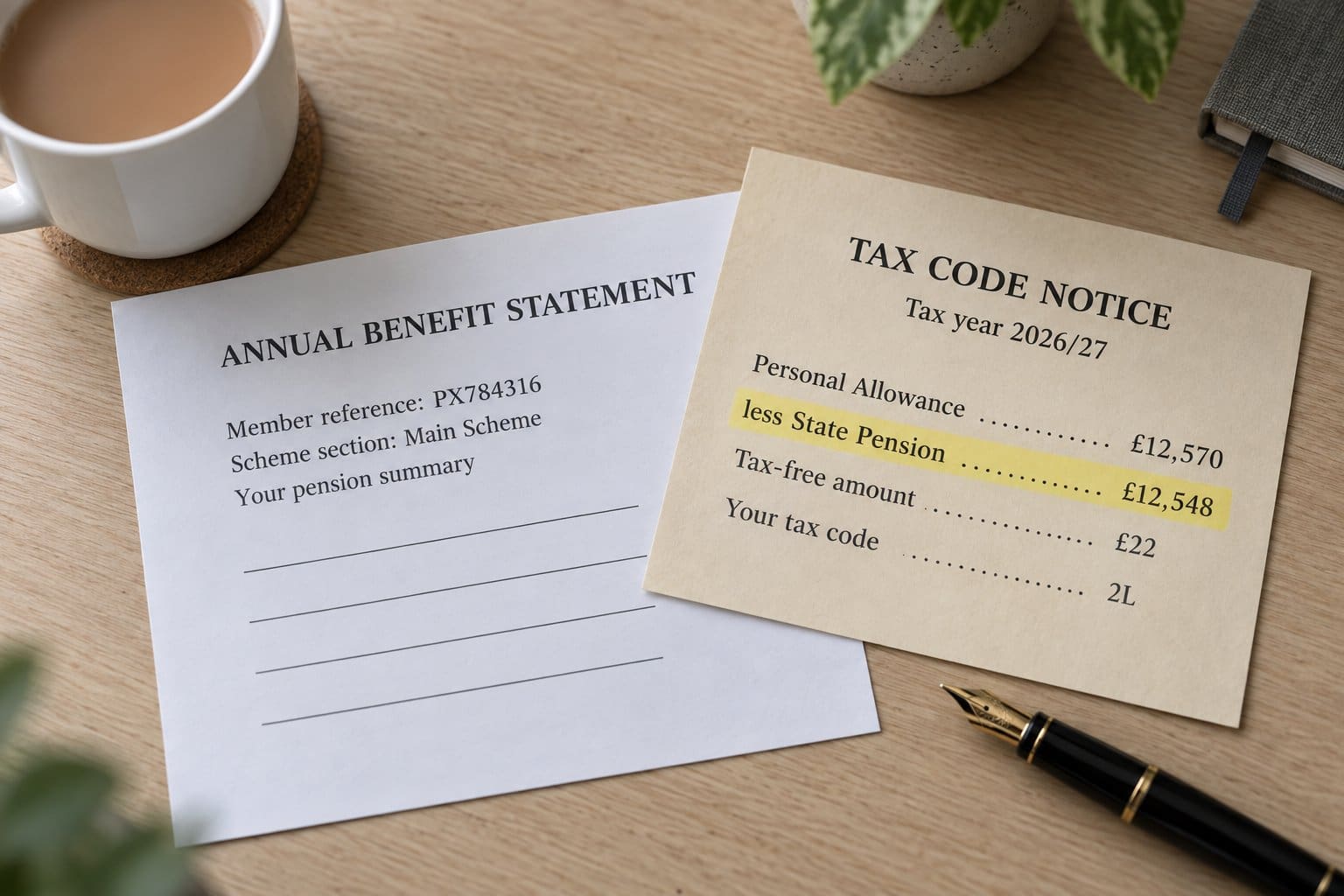
Today the sum works downwards and still lands above zero. The personal allowance is £12,570, a full new State Pension takes about £12,548 of it, and the £22 left over becomes a tax code of 2L against your scheme pension.
From April 2027, on a 3.9% rise, the State Pension is about £13,037. That is roughly £467 more than the whole personal allowance. There is no tax-free amount left to code, because the deduction has swallowed the lot and gone £467 past it.
When that happens the code stops beginning with a number and starts with a K. HMRC’s own description is exact:
Tax codes with a ‘K’ mean you have income or deductions which are higher than your tax-free Personal Allowance and are not already being taxed.
gov.uk lists the reasons a K code appears, and the second one on its list is getting the State Pension.
A K code works the opposite way round from the codes most people are used to. An ordinary code tells your pension provider how much to leave untaxed. A K code tells it how much extra income to add before working the tax out. The money and the liability are the same; only the direction of the arithmetic has changed, which is why a K code reads as bad news when nothing about the bill is new.
Two points before the notice lands.
Nothing has gone wrong. A K code carries no penalty and says nothing about arrears. It is what a tax code looks like once untaxed income has grown past the allowance, and on current projections a great many pensioners will receive one in the same April.
There is a cap, written into the rules. gov.uk again:
Employers and pension providers cannot take more than half of your pre-tax wages or pension when using a K tax code.
So a K code cannot take more than half your scheme pension in tax, however large the deduction behind it. For a member with a small scheme pension and a full State Pension, that limit is what stands between them and an alarming payslip.
Public sector pay grew 6.3%. What that means in a career average scheme
Now the second figure.
In the same release, annual regular earnings growth was 6.3% in the public sector against 2.9% in the private sector. Public sector pay grew at more than twice the private sector rate.
The ONS attaches a caveat that matters: public sector pay growth “continues to be affected by variations in the timing of pay awards this year.” Some of the gap is a timing artefact rather than a real divergence, and it may narrow on later prints.
Here is why it belongs on this site rather than in the general coverage. Every one of the main public service schemes is now a career average scheme. Your pension is built from a slice of your pensionable pay in each individual year, banked and then revalued, rather than from your salary at the end. A year of strong pay growth is a permanently larger slice for that year, for the rest of your life.
Two precisions matter, and most coverage of national pay figures skips both.
6.3% is an economy-wide public sector average, not your pensionable pay. It covers every public sector employee on every pay framework. Your own figure depends on your scheme, your grade, your increment date and your award. Your annual benefit statement shows what was added to your pension for the year, and that is the only number that describes you.
Pay growth and revaluation are different things. The slice banked in a given year is set by that year’s pensionable pay. What happens to it afterwards is revaluation, which runs on a different measure and a different timetable depending on your scheme. A strong pay year and a strong revaluation year are separate events.
Frequently asked questions
What does a K tax code mean on my pension?
It means you have income that isn’t taxed any other way, and it comes to more than your tax-free Personal Allowance. For many pensioners that income is the State Pension. Your pension provider adds the amount to your pension before working out the tax, rather than leaving part of it untaxed. In Scotland the code starts SK, and in Wales CK.
Why might my scheme pension get a K code in April 2027?
Because the full new State Pension is on course to pass the £12,570 Personal Allowance. A 3.9% rise in April 2027, where the earnings measure currently points, would make it about £13,037 a year, roughly £467 over the allowance. The final rate depends on September’s inflation figure. HMRC collects tax on the State Pension through your scheme pension’s code, so once the tax-free amount runs out, it becomes a K code.
Do I pay tax on my State Pension if I also have a public sector pension?
Yes, and you already do. The State Pension is paid with nothing taken off, but HMRC collects the tax on it through your scheme pension’s tax code, which is known as coding out. The 2027 easing announced at the Budget covers only people whose sole income is the basic or new State Pension, with no increments, so it does not apply if you also have a scheme pension.
Can a K tax code take all of my pension?
No. Employers and pension providers cannot take more than half of your pre-tax pension when using a K tax code. That limit matters most to someone with a small scheme pension and a full State Pension, where most of what is being collected is tax on the State Pension.
Why did my scheme pension tax code drop when I reached State Pension age?
Because HMRC has moved the tax on your State Pension onto your scheme pension. It cuts the tax-free amount in your scheme pension’s code by roughly the value of your State Pension, so more tax comes off that payment. Nothing has gone wrong. The tax on a modest scheme pension can look far too high when that pension is carrying the tax for both.
Who do I contact if my tax code looks wrong?
Contact HMRC, not your scheme administrator. HMRC sets the code; the scheme only applies it. When your coding notice arrives, check the State Pension figure on it, because HMRC codes out an estimate. If that figure is wrong, the difference turns up later as an underpayment or a refund.
Pension Plain’s take
The reporting on 15 September ran a simple line: the State Pension passes the tax-free allowance, so pensioners start paying tax. For a reader with a public service pension nearly every part of that is misleading.
Your State Pension has been taxed in your hands for as long as you have had both pensions. The relief announced for 2027 is aimed at a group that explicitly excludes you. And the change that affects your income is a frozen allowance meeting a pension that rises every year, which has been raising your tax bill a little at a time since 2021 and will keep doing so until 2031. The crossing point is a headline, not an event.
The new fact for scheme members in that release is the one nobody led with: public sector pay grew at more than twice the private sector rate, and in a career average scheme a strong pay year is banked for good.
Where to get help
Pension Plain explains how the rules work. It does not give financial advice, and nothing here takes account of your own circumstances.
- MoneyHelper offers free, impartial, government-backed guidance on pensions and tax: moneyhelper.org.uk
- For regulated advice on your own position, an FCA-authorised adviser is the route. The register is at register.fca.org.uk
- For a complaint your scheme administrator has not resolved, the Pensions Ombudsman is at pensions-ombudsman.org.uk
- Questions about your coding notice go to HMRC, not to your scheme administrator. HMRC sets the code; the scheme only applies it.
Pension Plain is not authorised or regulated by the Financial Conduct Authority. This is information, not advice.
Sources
- ONS, Average weekly earnings in Great Britain, released 15 September 2026. Total pay 3.9%; public sector regular pay 6.3%, private sector 2.9%; ONS caveat on pay-award timing.
- ONS, Consumer price inflation, UK: August 2026, released 16 September 2026. CPI 3.1%, core CPI 2.6% unchanged.
- gov.uk, The new State Pension: “The full rate of new State Pension is £241.30 a week.”
- gov.uk, Income Tax rates and allowances: personal allowance £12,570.
- House of Commons Library, State Pension triple lock.
- HM Treasury, Budget 2025: Strong Foundations, Secure Future, November 2025, paragraph 4.167.
- gov.uk, Understand your Simple Assessment tax bill.
- gov.uk, Tax codes, section “If you have a K in your tax code”.
- gov.uk, Tax codes, section “What your tax code means”: the letters table, including S (rates in Scotland) and C (rates in Wales).
- HMRC, PAYE Manual, PAYE11015: a K code prefixed with S (for example SK99) for Scotland, and with C (for example CK99) for Wales.
Footnote on the earnings measure. The triple lock uprates by the highest of earnings growth, inflation or 2.5%. The inflation leg is September CPI, published in October, so the April 2027 figure is not final yet. The earnings leg uses total pay including bonuses for May to July, which is why this piece uses 3.9% rather than the 3.5% regular-pay figure in the same release. That measure is derived rather than quoted: the last three upratings, 4.8%, 4.1% and 8.5%, match total pay for May to July in each preceding year exactly.